Ep 5. How to Sell to People Who Sell for a Living
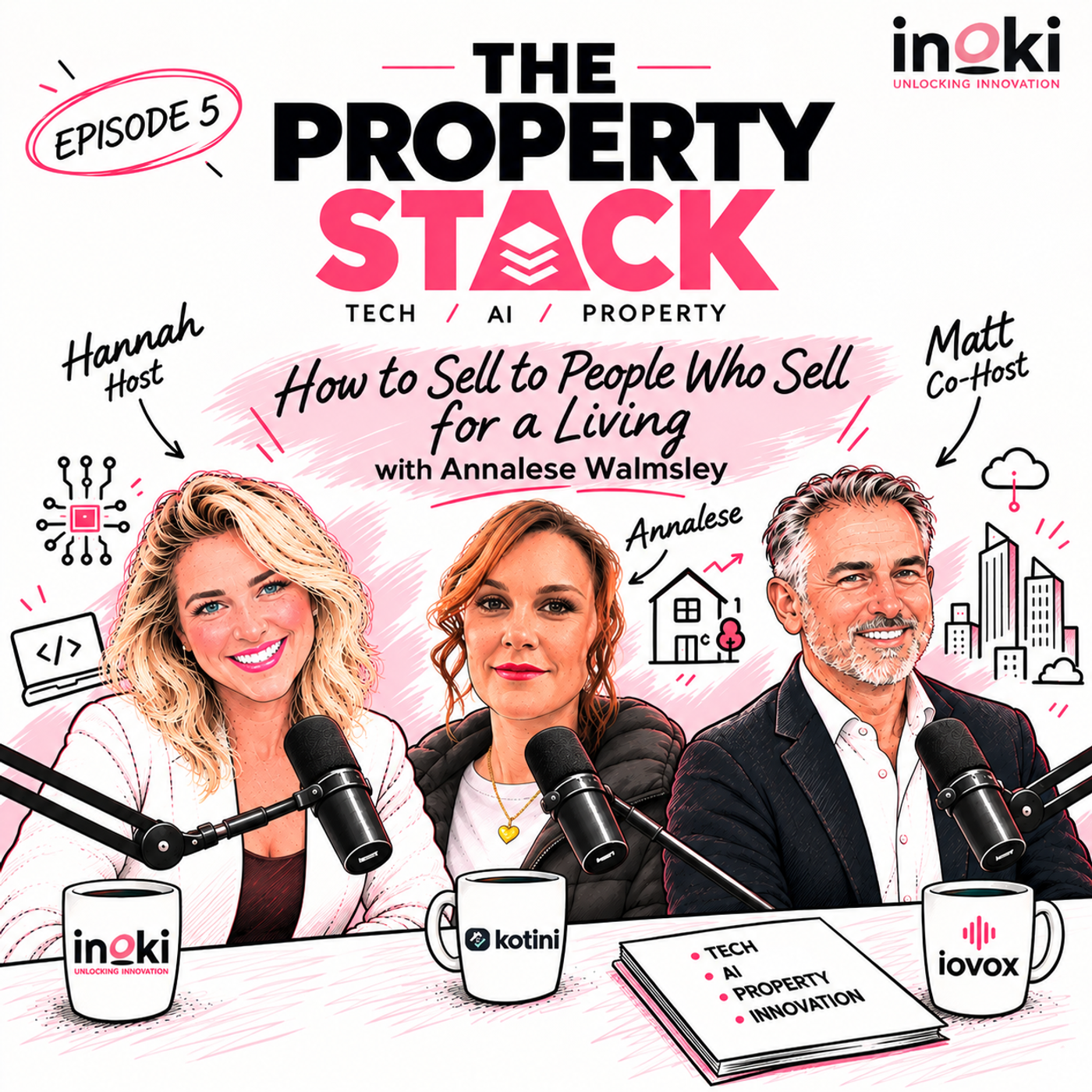
How do you sell to people who sell for a living? Kotini’s Annalese Walmsley on why pitch slapping never works, and why AI should be like a good pair of pants.


There are around 700 proptech providers chasing UK estate agents every day, and every one of them claims their tool will be the miracle they didn’t know they needed. So how do you sell to people who sell for a living? That’s the question at the heart of episode 5 of The Property Stack, as Hannah Parker and co-host Matt Gayleard (from our sponsor iovox) are joined by Annalese Walmsley, Sales Director at Kotini, fresh from the company’s triple win at the EA Masters 2026.
Annalese shares with us her tips on how you sell to people who sell for a living, why pitch slapping never works and how AI should be like a good pair of pants!
“The fastest way to lose them is to actually pitch them.”
Annalese takes us through her unexpected route into property, from nursery nurse to PA before landing in the proptech world, through Zero Deposit, Flatfair and Homebox to her fourth startup. She shares why consultative selling beats the pitch every time, what agents should ask before buying any new tech, and why word of mouth is still the best lead source going.
Hannah, Matt and Annalese also dig into the AI noise in sales outreach, how Kotini helped one agency cut its time to market from 14 days to five, and whether AI-savvy consumers spell trouble for agents and the big portals.
Incredible guest, thank you Annalese! For more information check out kotini.co.uk
The Property Stack is presented by Hannah Parker of inoki, and Matt Gayleard, CCO of our show sponsor iovox
Hannah: how do you sell to salespeople? Because agents are the hardcore salespeople. when you draw a salesperson, you think of cars, you think of property, How do you sell to them?
Annalese Walmsley: Well, I think the fastest way to lose them is to actually pitch them. If you start going, we've got this great product and it's going to do X, Y and Z for your business. Immediately the shutters close and they're not interested in talking to you. I think it's always about consultative sales in PropTech to estate agents and probably similar to every other industry in that you need to be solving a problem that they actually have in their business. So there's lots of tech out there that is great to have, can improve this, can add that. But if you're not solving an actual problem in their business, a problem that they can see and feel, then you're not even gonna get through the door. they are constantly bombarded with sales pitches, email marketing, LinkedIn DMs. events, it comes out everywhere. think there's about 700 prop tech providers in the estate agency space alone. So you can imagine how noisy that is for an agent who's running a business
Hannah: Welcome to the Property Stack, where our guest today went from nursery nurse to almost a PA to deep into PropTech startups and has been selling SaaS to the industry ever since. Annalese Walmsley is the sales director of Kotini the digital onboarding platform helping UK estate agents get homes to market faster. Today Annalese shares with us her tips on how you sell to people who, well, sell for a living. Why pitch slapping never works and how AI should be like a good pair of pants. and I'll add a quick note that since we recorded this episode, Kotini has gone on and swept the board at this year's EA Masters, winning Best Medium Supplier, Gold for Innovation and Improvement, and the overall best estate agency supplier. So huge congratulations to Annalise and the team.
IOVOX SPONSOR: This episode is sponsored by our partner, iovox the data and AI specialists. iovox tracks every lead back to its source and turns every conversation into a booked appointment or closed deal. I've used iovox myself over the years and honestly, they're just one of those no brainer tools that I recommend to nearly every lead generating prop tech business that I work with. For more information, visit iovox.com.
Hannah: Annalese welcome to The Property Stack It's so great to have you here. Thank you so much for giving us your time today.
Annalese Walmsley: Well, thank you for inviting me.
Hannah: It's great more women in the pod It's brilliant I'm
Annalese Walmsley: More women.
Hannah: just gonna get dive straight in and just find out a little bit more about you So I'm really interested in your story and at least like you've had different roles in your career in different companies I'm always intrigued about what gets people into the property sector and what keeps them in the property sector as well because it's a This is like a breed of us that that we absolutely love it. So I'm really interested in your So tell us how you got into it.
Annalese Walmsley: and you know what? This is going to sound so typical, but every person that says this is, I accidentally fell into it. I was
Hannah: Yeah.
Matt Gayleard: Okay.
Annalese Walmsley: due to get married. I was June 2015. And I just thought, I just wanted a little part-time job in an estate agent as a PA. And ironically, been out with the PA for, or I interviewed to be the PA for one of your previous guests. So Ian Preston.
Hannah: We love Ian.
Annalese Walmsley: love Ian and does you know his office is down the road from me so I interviewed to be his PA and he was like actually Annalise I think you'd be really great in this new prop tech startup business that I've launched and will you come on and be operations manager? Me being me I was like well what's the worst that can happen I can try it I can see what what happens and if I fail I find something else that's always been my my lifetime motto. And I just got into it and then started getting into the sales side of PropTech. The product that we were selling was customer feedback for estate agents, know, gathering customer feedback from vendors, buyers, tenants, landlords, all the way through their journey with the agent. And my role was more the operational side, data reporting, and stuff that actually I'm not very good at and I don't enjoy, but I did.
Hannah: Thank
Annalese Walmsley: And then naturally moved into more of a sales role when my boss at the time then left and they said, actually, do you want to step in? Do you want to kind of take on the sales side of things? And I just found that I really loved working with estate agents and I really liked working in tech. And so I did a couple of years there and then moved into a product called Zero Deposit, which is a deposit alternative and been around for quite some time now. It was a little bit of a disruptor tech back in its day. So nobody'd ever. use deposit alternatives, everyone had thought, well, cash is king, let's stick with traditional I was a regional sales manager there and literally spent most of my life in my car up and down the country, visiting estate agents, Oxford one day, Newcastle the next, and just whizzing around. And just really found there that my passion wasn't just estate agency and prop tech, it was startups and scale up businesses. So going into businesses where they had a new product or a concept and essentially convincing estate agents that this is a good product for them to have in their business. So I left Zero Deposit through redundancy and went over to their biggest competitor, which is a company called Flatfair, where I spent four years kind of, again, just growing, developing, ended leaving there as a commercial director, and then went to another startup scale-up business, which is a company called Homebox. Then did a little bit of a squiggly career thing and went into agency of sorts with LSL Estate Agency franchising as franchise sales director. Where I quickly realized I'm not built for the corporate world and being a number on a payroll. I like being in the business, in the weeds, involved in marketing, content, strategy, events, sales. So I was approached by Kieran. who's our CEO and co-founder here at Katini and found myself in startup number four. So here I am and yeah, my kind of career before that was I was a qualified nursery nurse, worked in private nurseries and schools. So very different to lots of people that come into our industry.
Hannah: Wow, what a story, it's great. I love that because it shows that you've been like both sides of the fence, I suppose, like being able to understand it. And when we're looking at sales. in in proctech environments selling to your state agents whether that's from you know a huge portal or whether that's from a startup just coming out of the ground. Having that knowledge of both sides of the fence must be really useful for you to understand. It's one of the first questions that I have actually written down here which I'd love to get your take on and Matt probably bringing in a bit of your insight as well to this. I think it's a topic that's really interesting for a lot of people especially especially as a lot of people are launching or they're trying to grow their own prop tech businesses at the moment, is how do you sell to salespeople? Because agents are, they are the hardcore salespeople. when you draw a salesperson, you think of cars, you think of property, know, they're there. How do you sell to them?
Annalese Walmsley: Well, I think the fastest way to lose them is to actually pitch them. If you start going, we've got this great product and it's going to do X, Y and Z for your business. Immediately the shutters close and they're not interested in talking to you. I think it's always about consultative sales in PropTech to estate agents and probably similar to every other industry in that you need to be solving a problem that they actually have in their business. So there's lots of tech out there that is great to have, can improve this, can add that. But if you're not solving an actual problem in their business, a problem that they can see and feel, then you're not even gonna get through the door. Because if they think they don't have a problem, you've not got a solution immediately, so you kinda get shot down. So yeah, they are hard to sell to because they are constantly bombarded with sales pitches, email marketing, LinkedIn DMs. events, it comes out everywhere. think there's about 700 prop tech providers in the estate agency space alone. So you can imagine how noisy that is for an agent who's running a business and everybody's telling them that this next bit of tech is going to save them money, give them time back, going to revolutionize their business. That's not how I or my team sell. It's this is the problem. This is what we fix. It's very direct. rather than this tool is going to change the way you work because there isn't any tool out there in my opinion that changes the way that every estate agency works.
Hannah: Yeah, I think I super agree with you. Starting with a problem is always a good conversation starter, if nothing else, that shows that you understand the business.
Annalese Walmsley: I suppose sometimes though Hannah, they don't know they have a problem. and this is the fundamental flaw is that most agency owners that I speak to haven't ever, or not in the last few years, ever looked at their business from, I hate the term, but a helicopter view and gone, okay, what does every single part of my business look like? How does every process system connect? They, they're so busy. that they don't have time to do that. And when they eventually speak to somebody like me or another provider that provides other solutions, they sit back, they take the time and they go, now I can see where this fits. But the challenge is always getting them to open their doors and let you talk to them, which is fundamentally the biggest challenge that we all have in sales.
Hannah: But from your angle, have you seen anything different or any other insights that have worked particularly well when selling to salespeople across the IOVOX group about that problem, about how do you actually get in the door in the first place when you're in a ocean of competitors that are trying to all sell, like Annelies says, like the number one, the game-changing solution that everybody needs?
Matt Gayleard: Yeah. I think I I I agree with everything you just said, Anis. I think we can't pitch, you can't sell to a salesman. and I think I don't my personal philosophy of sales, it shouldn't be that anyway. For me, the sale is a consequence of us having a conversation. So it's about how do we start a conversation is a much better place to start. and I think if you approach it from that point of view, you need to s you know, I think the problem solution thing is the right thing where you say, you know, my understanding or my belief is that you probably have this issue, this problem, that on a Friday afternoon you probably feel like this.
Annalese Walmsley: Mm-hmm.
Matt Gayleard: Let's have a conversation about that. And I think you kind of go in, and if if you show that kind of empathy and understanding of what it feels like to have that problem, just to kind of build on what you said, or or even surfacing the fact that I have a problem. Yeah, have you ever considered did you realize that this happens? And they go, Well, actually, yeah, that's always been there, and I've been staring at it all this time and I didn't really think about it, and I didn't even know that was a solution. I was on I was on a call this morning with with a prospect, and we were talking about some of the things that we solve, and they go, I didn't even know that was something that was there. So we've now showed them a problem that you didn't know was a problem.
Annalese Walmsley: Hehehehe
Matt Gayleard: So I think it's about having a a conversation with someone and helping them understand and look at this. problem that we fix all can help improve in some way. And and I think that's where you've got to know your audience. you've got to understand what their day is like and what problems they're having. And you've got to be a good communicator and storyteller and not try and sell to them. You're not trying to sort of you know use some secret dark arts of influencing. It's about, I understand this, we'll have an interesting conversation. And my job is to give you the information so that can make an informed decision. That's it. That is all my job is.
Annalese Walmsley: Yeah, absolutely.
Matt Gayleard: Whether you choose me or the other person, that's cool. But I just want you to have all the information that you might need to because choosing to buy tech for a business is scary and intimidating, and people don't want to be the person that bought the thing that didn't work. And the CFO
Annalese Walmsley: Yeah.
Matt Gayleard: and the CFO come tat them on the shoulder and say, we're wasting this ten thousand pounds a month. so again,
Annalese Walmsley: Yeah.
Matt Gayleard: yeah so I think our job is to help help people make confident decisions. I think that's And people Yeah.
Annalese Walmsley: Yeah, I would agree wholeheartedly. think fundamentally as well, there's two different issues in agency when it comes to new tech. One is fatigue. They've been trying new tech for years and there's always something new and something better coming along, especially now with AI and advancements and all that sort of stuff that's happening in the industry. And the second one, I suppose, is... companies and suppliers not actually identifying who their ICP is, like who actually needs our product. And they go out there and they try and land grab and get every single one man band, you know, corporate agency. And it turns out that product doesn't really fit with everybody. It has a core audience. And if you target that core audience and you are very specific and you hone in on that specific audience, you're going to get much better results and much better engagement as well, think, Matt.
Matt Gayleard: Yeah, definitely. Definitely. And and I think that's that's what makes my team's job really hard, actually, is to to be sales at iVox is actually really hard because we don't have three packages in four sizes, and you go on the website and pick the one you want. We have a whole toolbox full of features and capabilities that based on your unique set of circumstances, we could probably put together a solution that's gonna work for you. but to do that we've got to figure out what's important to you, you know what the priority is, what's the biggest problem you wanna fix first. and kind of take people on that journey. And I think that's where, you know, you mentioned sort of consultative. That's really it's not a consultative selling is not a a trick. I think it's a philosophy. It's about saying, okay, I really I think I get what the problem is And I've got some good ideas of how we might solve that and then let's try and fix so rather than go, I've got a hammer, let's go and sell that to everybody whether they need it or not. it's not the right choice. I've got I've I've got
Annalese Walmsley: What do they call it pitch slapping? think that's a It's literally just where you think that everybody has the same problems you
Hannah: I didn't note this.
Annalese Walmsley: go in with the same pitch everybody gets the same whack at the side of the face and then you turn around and go actually that person did yeah Yeah You can have that phrase
Matt Gayleard: That's that's that's pretty
Hannah: been pitch slapped. I love that. I learned something today. Thanks.
Matt Gayleard: I'm I'm not sure I can pull that off. I think that's inappropriate. So but I think it's very funny.
Annalese Walmsley: That's the beauty of working in sort of disruptor startup tech, you can get away with
Matt Gayleard: Yeah.
Annalese Walmsley: a lot more than you can with a big business. One of my lifetime mottoes
Hannah: Yeah. Well, based on what...
Annalese Walmsley: is definitely to ask for forgiveness and not permission.
Matt Gayleard: Ha ha
Hannah: Yeah, we should all do that. It's super interesting. You both have obviously a similar stance of this consultative approach. mean, you've had time on both sides of this fence as well. I'm going to flip this over on the question and say, if you're an agent, let's say you're an agent listening to this and you're like, god, I can't have another tech company trying to pitch to me, pitch slap me or do this. If you were working in a real estate business and you know you want to grow your business like you're you're worried about what's happening you're worried about keeping up you're worried about like maybe that FOMO effect of missing out on a solution that is good and you know everything is claiming to be the best thing that in the world that's going to change their life What questions do you think that these business owners should be asking to get that helicopter view? Like you said, what are the key things that they should be asking anyone that is trying to pitch to them so they can have a quick assessment of like, is this something that is a product market fit for me? Is this something that truly will make a difference or is this just more noise that it might be a great product but it's just not a great product for me?
Annalese Walmsley: Yeah, think the first thing is every agent should really have a really robust overview of their entire process of tech stack. I think they should be able to very quickly say how does a client get from A to B to C in their business and every single piece of tech that that customer touches or their team engages with during that process. If you can't do that, you're not close enough to your business to understand whether this piece of tech is going to actually make a difference. And that can be make a difference to your clients, your vendors, your buyers, your tenants and landlords, or to your team who are actually doing the work. So first of all, that's what I say to every agent is identify what does your tech stat look like and where are your pain points and frustration points with your team as well. Because quite often the person doing the job doesn't really moan about the process because it's just how it is. But if you sit with your team and you identify, okay, these are the weak points, this is where we're strong, this is where we need to add a layer of tech or something like that, you've got a really strong basis and you immediately know what you're going out to market to look for and almost what prospecting activity you will accept. Because if you know that you've got a gap in, I don't know, compliance, because that's kind of our area, I'll just use that as an example, but if you know you've got a weakness or a gap in your compliance, you're more receptive to outreach from businesses or contacting them when you know you have a gap in your system and process. So that's the first thing I would say. I think the second thing is peers. There is over 20,000 estate agents in the UK. Lots of them belong to groups such as Leaders Inc, which obviously Ian Preston does a lot with. There's the Relocation Agent Network, the Guild. There's lots and lots of groups in this industry. reach out to your peers and ask them what they recommend because word of mouth is the most powerful, particularly for suppliers. Case studies, testimonials, Google reviews and referrals are the best lead source that we could ever imagine. So ask your peers who are they using? Why is it great? And ultimately what are the pitfalls of that as well? So they might say, yeah, it's great because it does this, but actually they take.
Matt Gayleard: But I'm not going to
Annalese Walmsley: days to reply to customer support. depending on your business, you might be happy with that, or you might say, actually, we're such a streamlined, fast moving business, we need fast support. So therefore great product, slow support isn't for us. those would be the two main things that I would say, understand your business, understand your gaps and your pain points and reach out to your peers to find the right solutions for your business.
Hannah: I think that's brilliant advice. It's even more timely for the advice at the moment with the influx of new fast-made AI solutions that are hitting, I know, lot of real estate inboxes across the world of things that have been created like... a little bit over promise and under delivery. I think is the tagline for a lot of these that have been made quickly with people trying to find a very quick solution and agents, brokers, people working, real estate, the customers struggling to really understand what's real in this noise, what's really going to add value and what is just like another flash in the pan product that's not working. It might take a bit of time to get some of those reviews that you were talking about but I think that's great advice and it's probably something that people don't do enough actually is to use that network.
Annalese Walmsley: Yeah, talking of AI, had a great phrase. I don't know whether you've heard of Toby Martin in our industry. There's a lot of consultancy and training and he said, AI should be like a good pair of pants, supportive and practically invisible. And I use AI in our business. don't think we can or anybody can claim these days that they don't use AI in some way, shape or form. I'm a big fan of Claude. I use that for quite a lot. but nothing beats that personal human element, whether that's on LinkedIn, whether that's in your emails, marketing campaigns. Yes, you can blend it with AI, but having it completely written by AI becomes what do they call it? AI slop, basically, and it speaks to nobody.
Hannah: How important is... LinkedIn to Art Ek and ours to both of you right now as a tool for contacting people with it has been criticized. The criticism of LinkedIn has increased incredibly in the last six months, particularly with how much more like AI content that has been populated, that it's just becoming more noisy and the turnoff rate obviously is being affected by that. How important is it still as part of your go-to-market structure and your sales structure?
Annalese Walmsley: interesting question because I would say that it has become less useful over the last two years versus any time prior to that. think when you had a connection with somebody on LinkedIn, you could send them a message. may, would not always, but you were more likely to get a response from somebody then versus now LinkedIn DMs are almost non-existent. Nobody engages with a LinkedIn message that comes from Sales Navigator. However, LinkedIn has proven useful in terms of looking at networks, who are the influences in that business, who do you need to connect with? And then there are now tools that connect to that, like Apollo, there's various other ones out there, to obtain contact information. So how do I get in touch with you directly that doesn't come through LinkedIn where it feels like a LinkedIn DM that's unsolicited? Even though an email is unsolicited, it feels less unsolicited than done a LinkedIn DM, in my opinion, and I might be wrong with that. But in terms of personal brand, in terms of company brand, it's become very valuable to us, as long as we're consistent and you're not putting a lot of AI out there, you're combining work with personal. So if you look at my LinkedIn, there's a very mixed genre of topics that I talk about, all stuff that I'm really passionate about. but it's very less, it's much less salesy than a lot of the other salespeople that I see going out and just talking about their product day in, day out.
Hannah: Yours is very authentic, would say, Annalise, so from what I register, so
Annalese Walmsley: I try to be.
Hannah: yeah, everyone should follow yours. It's a nice authentic voice. That's good. Matt, do you
Annalese Walmsley: Thank you.
Hannah: still use LinkedIn a lot within the sales team and work
Matt Gayleard: Yeah.
Hannah: globally?
Matt Gayleard: I'd I'd say for us it's it's really important. but we are really, really targeted. So, you know, I think it's about finding the person that you should be speaking to. an AI might be able to help you do that faster. So you mentioned Apollo AI and some of these other things where you know there are tools that help you identify the people. you can ask your favourite, you know, Chat GBT, Clause, others are available, to do the research for you and find the people in those companies and do the background research. So I think from an account based marketing point of view, which I really think we should call account based prospecting, the research that could be done automatically while you go and do something else is really valuable. But then You take that information and then you've got to write to them yourself. And I think that's the key, is where I think the people that we're targeting are probably people that are using AI themselves a lot and are the most discerning and will spot AI written slot from
Hannah: Mm-hmm.
Matt Gayleard: 100 yards. so I think it's really important that you have your own voice and that you and you write the message, and you might use the AI to help you get the research in the background and the target, but I think you've got to do that personal outreach, and if you can set up. 100 messages that day, I still think you should write each one, and I think it comes across in that message. and I think it's not about tricking people. you know, I think sometimes ABM can sound like stalking. I saw that you went so-and-so, and you well, that's
Annalese Walmsley: Yeah.
Matt Gayleard: creepy. so I think it's more about you know, I see that you're interested in this thing, and you might be finding this article I've just sent interesting. Maybe we should have a chat. So I think you've got to add value, and I think you can't just go for. the demo. I think you've got to add value from the conversation. Yes. Yeah. We
Annalese Walmsley: Yeah, hey, let's talk. Yeah, but yeah.
Hannah: Yeah.
Matt Gayleard: I've got a solutions of all your problems, call me. I think that's not the how do I add value to this connection? Because they're probably gonna get ten others unsolicited that day as well. So I think you've
Annalese Walmsley: Yeah.
Matt Gayleard: got to you've got to add value otherwise and be relevant and not sound like an AI, I think. But it's still very it's still very valuable for us to connect with the right people. But it's just one of the tools to do that.
Hannah: Yeah.
Annalese Walmsley: Yeah.
Hannah: Okay, well, it's good to know.
Annalese Walmsley: I think you've got to be careful as well. You said there, about people using AI to do research, to draft messages that sound personal, but actually AI can, what do they call it, hallucinate. So it can almost draw its own conclusions. And
Matt Gayleard: Absolutely. Yeah. Yeah.
Annalese Walmsley: I've seen it being done and it's like, I can see that you do this. And it's like, actually, no, that was my business part there. So, even if you
Matt Gayleard: Yeah.
Annalese Walmsley: are using AI, you've got to verify that as a person that that is actually true.
Matt Gayleard: Exactly.
Annalese Walmsley: and you cannot trust it at the moment, really. It's great, it's a great tool and I wouldn't tell anybody anything else, but it doesn't know everything.
Matt Gayleard: Yeah, I agree. And I think I think going back to your Toby Martin pants quote, which I thought was
Annalese Walmsley: Yeah.
Matt Gayleard: great, the one I use often is it's it's like an e bike. I've still got a pedal and I've still got a steer and decide where I'm going, but it's gonna definitely help me get up the hill a bit faster, with a bit
Annalese Walmsley: Yeah.
Matt Gayleard: less effort. And I think that you're still in control. You don't just kinda let go of the handlebars and shut your eyes. And I think we've that's how we've got to use it is to give us superpowers to do the thing that we're good at quicker, faster, with a bit more ease. but again I I think Yeah.
Annalese Walmsley: Yeah, it's moved away from just dashes. People think, it's an dash, it's AI. You can't identify it from that anymore.
Matt Gayleard: Yeah, yeah, definitely. but yeah, I th I think it's I think it's moving so fast and we've got to just figure out what you know, where it's appropriate and where it helps and where where it doesn't. But there's just and the other and the other thing is it just has it has no kind of word count restriction. So
Annalese Walmsley: Okay.
Matt Gayleard: you know, brevity is not what it's good at. So often it will just go on and on and on and on. So I think I think that's why the other tells quite often that, you know It's an eighty four page of message in a thing. I think it's just gotta Yes. Yeah, definitely.
Annalese Walmsley: Yeah, it's trying to tell you everything all at once. Yeah.
Hannah: It's that friend, why use one word when 10,000 will do?
Matt Gayleard: Excusez-moi.
Hannah: So if I go back to the value part, think that one of the other questions I had on my list, Annalise, was to know a little bit more about after you've used all these great tools to be able to speak to the agents. is what's the killer value part for what you're offering into the agents that they really kind of hook onto really quickly? And it's that first, I know it's a coined phrase, but that aha moment, but that moment
Annalese Walmsley: Okay.
Hannah: of value when you're speaking to the customers about your product, could you tell us a bit more about what it is that you offer and that moment of value that they see really quickly?
Annalese Walmsley: Yeah, and so for us, when we're speaking to an agent, one of the first things we do is we have a discovery call and we understand what are they doing in their business right now. And so what Cattini does as a kind of a holistic elevator pitch is we are a digital onboarding solution that basically it removes four or five different systems from getting a vendor to say they want to list their property to being on the market. And that includes signing terms of business, ID, anti-money laundering checks, material information, legal protocol forms and upfront payments. All of those at the moment for most agents sit in four or five different systems, are sent out manually and then having to be collected manually, chased manually and don't integrate into their CRM. So whatever they're using day to day, they're having to use these things in silos outside of their system. What we do with the agent is we sit with them and say, okay, you're probably using DocuSign, you've got an ID provider, you've got paper forms, you're sending invoices out for payments. And when they've gone through that journey with us, and we say, well, all you need to do with our platform is send one link, it integrates into your CRM, customer does everything in one branded journey, and then everything they do pushes back documents, updates, all of the information. That's the moment that they go, so... I can get rid of these four systems and processes. I can send my customer one link. They're going to have a much better experience because they're not scrambling in their inbox for this link and this logon on this platform. And everything is going to feed back into my system, which is going to help me become more compliant if I'm ever audited by HMRC, for example, on what is my anti-money laundering policies, how am doing my risk assessment. So for an agent, it's sitting with them, letting them tell you what they do. and then saying, okay, well, we can remove four of those systems. You'll have one, and this is the experience that you'll now get as a customer working with us. And it really is that simple. And they go, why has nobody ever thought of this before? Or it's a no brainer. So one of the most common bits of feedback we get in a client demo is, well, why wouldn't any agent use this? And that's great, because it means that I've got quite an easy job when I get on a demo, because I know it's a great product. But as we talked about earlier, the problem is always how do we get more? How do we get more of them to understand that these solutions even exist in the market? Because at the minute, they're searching for anti-money laundering, they're searching for contract or digital docusign providers. They're not searching for something that encompasses that entire ecosystem before the property even hits the portals.
Hannah: So it's kind of like you said, they don't know what they don't know yet. So it's the education level of understanding where their business, how their business operates, where they've got pain points in their business. And then you've got the whole wrapper solution that comes in. Okay.
Annalese Walmsley: year. Because quite often it can take 10 to 14 days for all of that to happen. So if you're an agent and doing that manually, you're sending a contract out via email, you're sending an ID link and it's really disjointed or fragmented. And we've had clients that have taken it from 14 days to five. So they've dropped it by nine days. And that's nine days where a property isn't on the market, which is nine days too long in any market.
Hannah: And that's massive because as an agent trying to sell their service onto consumers by saying like, we can put your property on the market and get you an offer faster than the competition, that must be a huge benefit for them to be able to pull back in to differentiate themselves.
Annalese Walmsley: Tech plays a big part of that because if you open a bank account today, if you go to NatWest Barclays or any of these banks to open a bank account, you're not sent a contract through this link, an ID check through this link. You're doing everything under an umbrella of that bank. They don't send you out to do these things in isolation and customers now expect that level of service when it comes to putting a property on a market or big purchases. Agents have to move with the times and a lot of them still are quite happy with their paper-based contracts and their paper-based filing systems. But eventually with the new home buying reforms, digital sales packs coming in, agents are going to have to move towards a digital sale ready proposition and incorporate bits of tech like this in their business.
Hannah: For sure. What do you see as being the biggest threat? And I'm specifically thinking about kind of AI and technology changes. What do you think is the biggest threat currently to estate agents?
Annalese Walmsley: that's a very good question. Biggest threat. think it's consumer knowledge of them thinking that they know or have all the information already. You you can go to any of these MCPs and say, tell me the value of my home. And an agent is going to walk into that living room and they're going to go, well, I know it's worth 465 because it's told me through here and here's my comparables through Claude or whichever other tool. But actually. it requires a human eye to go into that property because they might have had refurbishments, a new kitchen, actually they might have a smaller bedroom than the one that's sold down the road. So I think the biggest threat is that consumers now can go to AI to write complaints, to do their own comparables, to search for properties. And I think that is going to be the problem to get legal advice. know, people are using it to get conveyancing advice and things like that as well. So I think we're in an era where more people I think will try and sell their own homes privately through online portals and list them there but actually deal with the transactions themselves because they've got a lawyer in their AI, they've got a valuer or a negotiator, they've got all these things built in and you can build different identities within your AIs as well. I think we are, it is something to be worried about in my opinion. I sold my own home, bought my own home. it was sold privately so I'm one of those people.
Hannah: That's super interesting, because the... The UK is one of the lowest in the world of for sale by owner, private sales that coming. bought my home privately, but my home, but that's in France where it's it's anything up to about 40 % of the market in the UK. It's very, very low. So you would definitely be in a very under 1 % category of sales that fall through. But you but the take is really interesting. I wonder whether that will that will see that percentage change as you say is people feel like they're the prosumers. think there's a phrase isn't it when
Annalese Walmsley: We.
Hannah: consumers they become their own professionals but it's an interesting it's an interesting tape. Are you using a be... Go for it it's my favourite topic!
Annalese Walmsley: I think portals as well, know, let's talk about portals. know, I think AI is, AI is, and we're seeing tech out there. So Mal, Mal
Matt Gayleard: No.
Annalese Walmsley: MacKillian and what he's building, you know, we're seeing portals almost become like not even the middleman anymore. You know, you can go to AI and you can create your own short list of properties, even without the portals that now are being built. You can still get it to do that for you today. without an intermediary system in the middle. So I do think portals have got a lot to invest in AI tools and maybe reducing some of their fees, some of them.
Hannah: Do you think they're at risk?
Annalese Walmsley: Definitely, definitely. think they're at risk of, like you say, the pro consumers going out and sourcing it themselves and also of tech that's going to come out that is going to make it easier with less resource, less headcount, all of those things that are going to ultimately drive businesses like the big three lower down the list.
Hannah: It's interesting. It's one of my favorite topics to talk about for marketplaces. I always love hearing different opinions on where it could go. For AI usage and AI, so for you and your business day to day, how much has changed in your business in the last 12 months with the adoption
Matt Gayleard: Yeah,
Hannah: of AI?
Annalese Walmsley: massively. We can ship and deploy tools, features, things to agents so much quicker. A great example of that is clients are asking for a billing dashboard and we could go to this tool and we could have it built within a couple of days, whereas previously it had taken a team of engineers a few weeks and scoping. I use Lovable quite a lot for building kind of things as well. I use it with my daughter who's nine as well, she loves it. and getting them started early. But I think the deployment of new features, tools, and testing things becomes a lot easier because you can build a tool, test it in a sort of separate environment before deploying it to your full product stack, which we've done with risk assessments and things like that. I think it makes it easier to digest a lot of information. If we're looking at a lot of data, market data, insights on property values, things like that, I would historically have spent days sitting in a dark room questioning my life choices, looking at lots and lots
Hannah: Yeah.
Annalese Walmsley: of data. Whereas now I can give it that data and I can specifically lean in on the points that I want to get from that data and how I then want to present that data further on down the chain in the business. So I think it's massively improved the way that I work and I couldn't imagine not using it day to day now.
Hannah: And how... When you first got started using it, because it sounds like you're using it not just in operational and behind the scenes, but you're also using it within the product and the development. Was the learning curve of that difficult? Was it something that you were intimidated by or you felt quite comfortable to go in? Because I think there's a lot of people that have curiosity around AI. They have curiosity around how it could make improvements to their business. of like, where do I get started? I don't know what I'm doing.
Annalese Walmsley: Hmm.
Hannah: And I'm talking more from people that just don't, are not from maybe a technical background, that haven't been involved in maybe startups and prop tech worlds where they've been more exposed to different technologies. People more in the sort of traditional property sense, where there is a huge amount of fear of new technology, whether that's gonna take my job or whether I can't keep up with it. How would you help those people? if they were looking like, don't know where to get started, I don't know how to start with AI, from your experience over the last 12 months, is there anything that you could advise for people about getting started?
Annalese Walmsley: think it's just to get, just to start using it, asking it generic stuff, if you're looking at local restaurants or start, just get comfortable with asking what feels like a computer questions, you know, and, and I, you ask Google when you want something, you go to Google, you ask for it. And I think people just need to have the confidence to just start. I think if you're not, if you don't have a, app on your phone or if you're not using it at work at the moment. just start asking it lots of questions and you'll be really surprised how comfortable you get with it pretty quickly. And also how much you challenge it. I know I do. I it questions back all the time. But a really good example of that is my husband. He works at Aviva Insurance Business, has worked there for 20 years. They sort of have AI, but not really. It's one that's added onto Teams and all he uses it for is to make images of my child's drawings or something really, really silly.
Hannah: Great.
Annalese Walmsley: But he looks at what I'm doing now and goes, that report you built for that looks amazing, but I can't do that with this IAI tool that I for work because it's locked down because it's a Viva. So I would say use it and go on courses. There's lots of courses available now for AI, how to introduce it into your business. You can obviously create your own data models and things within that as well, your own personal profile within it. So yeah, would say get on the courses, listen to the podcasts and download your first app and start using it because once you do, it's quite addictive. I don't know whether you experienced that.
Hannah: Yeah, so you mentioned you mentioned lovable. I think you mentioned Claude that you use.
Annalese Walmsley: Yes, yeah, I started with chat GPT. And, but very quickly learned there was a lot more I could do with Claude. And, and to be honest, it was quite scary for me moving from chat GPT to Claude because I was like, well, I've taught this GPT everything I've, you know, I've taught it over the last six months. How do I move that across? And someone was like, great, you just download the knowledge brain and you upload it to Claude and off you go. And from there, I haven't looked back, but yeah, Claude, chat GPT, lovable. The team here use all sorts of different AI connectors with lots of different things.
Hannah: any other products that you recommend.
Annalese Walmsley: I think those are my main ones to be honest. Yeah. I don't really rate
Hannah: to good list.
Annalese Walmsley: integrated ones like HubSpot Breeze. I find that pretty basic and not very good. I think a lot of these big companies are trying to build their own AI tools. They're just not as good as the ones that are built for it.
Hannah: It's hard to keep up because the pace of change is so high. Matt, any new tools that you've used recently that you would recommend to people?
Matt Gayleard: I'm using ChatGPT and Claude. So at work we are a Claude house. We are using it for everything. and I think using claude code for not just coding, I think was probably the biggest change. So I'm very used to using Claude, started using Claude Design, which is fantastic because one I'd say the biggest benefit we have is when we go to a meeting now, we can have a tailored presentation made specifically for that customer for that meeting when we go in. To do that in the past, you you kind of did for the really big important ones or the ones you hoped would be big. And important because it's such a big lift to do the research, write the deck, make it look pretty, and all the rest of it. We can show up to a meeting really, really well prepared and be updating it minutes before the call, if need be, because we just found that thing. So because I just told Claude Design and it just updates the slide.
Annalese Walmsley: one for me. did, Lovable did a free weekend. I can't remember. They did a free weekend,
Hannah: Yeah, they often do like, yeah.
Annalese Walmsley: unlimited credits. And I sat with my daughter who was eight at the time and she was like, I want to build a learning platform. And in that it was languages, it was maths, it was interactive and absolutely brilliant. She sent it to school. The kids at school now play it. like, so many people looked at it and said, my God, how long did that take you to make? I was like an hour with my eight year old. It was
Hannah: Yeah.
Annalese Walmsley: like, It was just, and for her and how old she is, it's incredible to see where that's gonna go. Scary at the same
Hannah: It's brilliant.
Annalese Walmsley: time as well. I think a little bit like, my God, what types of jobs are no longer gonna be available or serviceable to the everyday person because AI and tech can do that. But also incredible that she's exposed to this this age now and understands and isn't scared of it. I think that's the key thing.
Matt Gayleard: I think that's I think that's amazing. And I think I I remember when my son was eight and you said, What do you want to do? You know, I want to be a YouTuber. And you Whereas whereas I actually think doing things like that in Love Ball, that's that's fantastic. I don't just wanna be a person that just talks the camera on YouTube about stuff and nonsense. I actually I'm gonna build a thing
Annalese Walmsley: I want to design websites or I want to, yeah.
Matt Gayleard: myself that's useful and I think that's yeah, I think that's amazing.
Hannah: Yeah, it could be great if it does open up a world of creativity for people rather than kill it. It be good.
Annalese Walmsley: think it does though, I think it just goes well what's possible with it? What can
Hannah: Yeah.
Annalese Walmsley: you build and how far can you take it? And she kept taking it further and further and she was like I want it to have an audio recording thing so I can record the songs that I do on there and it built that within five minutes. had built like she had a piano, different bass and treble and then it had a record button and then you could stitch them together and it was like all of that
Hannah: Amazing.
Annalese Walmsley: just came from wouldn't it be great if it could do this? I was like well let's see if it can. And it did. So, it helped push the limit. I'll send it over to you.
Hannah: I will check out her app for the apps. Yes, I can
Matt Gayleard: Yes. I think she's
Hannah: have a player.
Matt Gayleard: gonna be on next week's podcast, Hannah
Hannah: Yeah, yeah, we'll book her in.
Annalese Walmsley: She'd love it.
Hannah: thank you so much for sharing some of these insights. It's super useful to share knowledge, to share how you're doing it personally, especially around sort of some the fear of like how to get started with AI and some of those tips of how to sell to salespeople. I think it's super useful. So thank you so much for giving us your time and coming on the show. Just before we close off, any other like, top products that you've used recently, book, series that's on your hot list at the moment.
Annalese Walmsley: a tool that I do use is Whisper, Whisper Flow, which is great because we talked about this earlier, Matt, of having like that personalization, your content, your emails. You know, if you're busy like we are, Whisper Flow, you literally just read, like tell it what you want it to type and it goes with it. And I can send double the amount of emails that I could previously by typing out by hand. I know I speak very quickly, but it keeps up with me and my tone of accent. So that's always a win. So that's one thing that I'd recommend. And then I'm unfortunately into all of these horror story type murder mysteries. So I'm a big monster fan. All of that, true crimes, absolutely. And
Hannah: You're true crime podcaster.
Annalese Walmsley: then I listen to a lot of industry podcasts as well. So yeah, I was on the train to London the other day and listening to a couple, two very different ones. Again, think everybody in our industry should immerse themselves in as many different types of podcasts as possible because they're all different and they've all got a different viewpoint.
Hannah: We all sit on a lot of trains, planes, cars and everything so it's
Annalese Walmsley: We do.
Hannah: a great way to learn while you travel for sure. Thank you, thank you ever so much. If I've got any true crime pods I will send them your way to have a
Annalese Walmsley: Fantastic.
Hannah: little look at. Have a great rest of your day and enjoy your weekend. Thank you very much for coming on by and hopefully we will get to speak to you again soon. Thank you. Bye.
Annalese Walmsley: Wonderful. Thanks, Hannah. Thanks, Matt. Bye.
Matt Gayleard: Thanks. Bye bye. Take care.
Han end pod: Thanks for listening and thanks to Matt and all the team at iovox for the questions. If you're working in property or tech and want help with growth or product innovation, then talk to me, hannah at inoki.agency Otherwise, see you next time. subscribe and like.

Sales Director
Annalese is Sales Director at Kotini, the digital onboarding platform helping UK estate agents get homes to market faster. Her route into property was anything but typical: a journey from nursery nurse to PA, to proptech (Zero Deposit, Flatfair and Homebox) before joining Kotini, her fourth startup.
Kotini recently swept the board at the EA Masters 2026, winning Best Medium Supplier, Gold for Innovation and Improvement, and Best Estate Agency Supplier overall. On The Property Stack, Annalese talks about how to sell to people who sell for a living, why pitch slapping never works, and why AI should be like a good pair of pants.